Yesterday (4th October 2026) the Green Party conference voted to adopt this motion. Less than 1% of members voted, but the motion is now official policy. I opposed the motion, and I spoke against it during the conference debate. I am deeply saddened and concerned that it has passed. Prior to the debate, I issued a statement opposing the motion. After the debate, I issued a statement together with other Green MPs and leaders reaffirming our party’s commitment to universal human rights. You can read both these statements below. I am committed to working to change and improve the Green Party’s policy-making processes, which are clearly not fit for purpose.
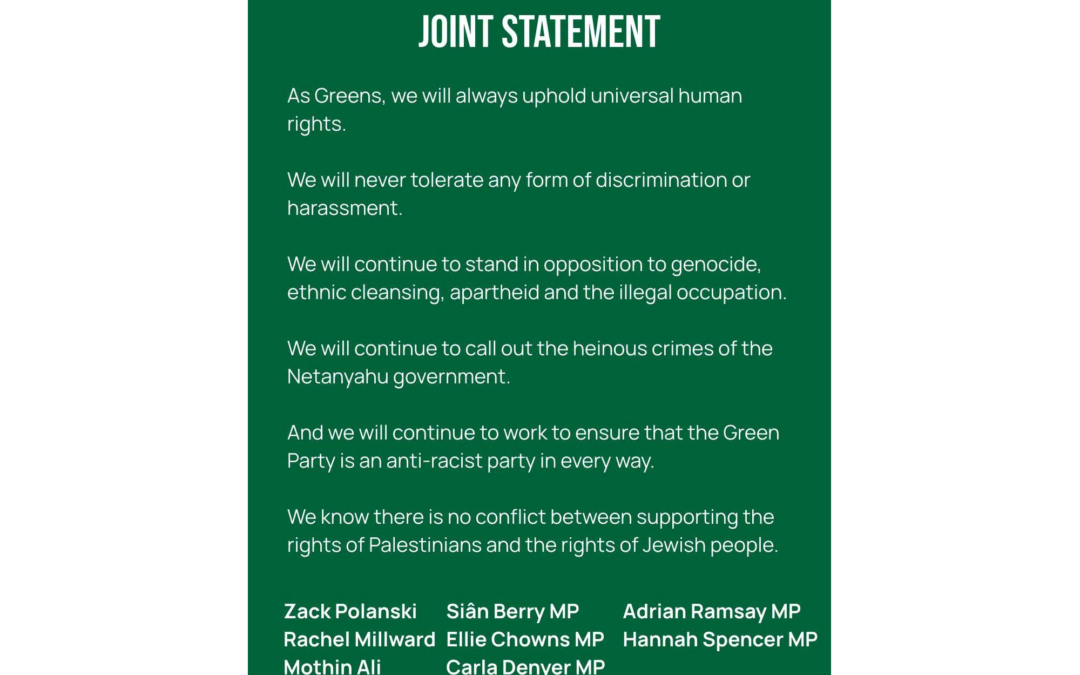
The joint statement:
Introduction by Ellie:
I do not support the “Zionism is Racism” motion and spoke against it at conference. I am deeply saddened that it has passed.
The statement:
As Greens, we will always uphold universal human rights.
We will never tolerate any form of discrimination or harassment.
We will continue to stand in opposition to genocide, ethnic cleansing, apartheid and the illegal occupation.
We will continue to call out the heinous crimes of the Netanyahu government.
And we will continue to work to ensure that the Green Party is an anti-racist party in every way.
We know there is no conflict between supporting the rights of Palestinians and the rights of Jewish people.
ENDS
Ellie’s personal statement posted on social media ahead of the vote read:
The Green Party has played a vital role in the campaign for justice and self-determination for Palestinians. We have raised our voices together against the heinous crimes of the Israeli government: against genocide, against ethnic cleansing, and against UK complicity through arms sales and trade. I am so proud of how our Green politicians have stood together, united.
I’m deeply concerned, though, that the ‘Zionism is Racism’ motion risks fuelling division, and risks undermining the Party’s ability to advocate effectively for justice and peace.
Zionism is a contested concept with no single definition. If this motion passes, the Party risks alienating many people, including in Jewish communities. Defining a highly personal and variable identity simply as racism risks reinforcing exactly the zero-sum politics we desperately need to get beyond.
And debates about the meaning of a contested political ideology distract attention from where Green policy can be most concrete and influential: calling out genocide and ethnic cleansing, ending the occupation, protecting Palestinian rights, securing accountability for violations of international law, opposing UK complicity, and supporting self-determination, equality, and human rights. That is where our focus should remain.
Our commitment to the principle of self-determination means we should not prescribe the constitutional form that Palestinians and Israelis should ultimately live under. That choice must belong to the people whose future is at stake, Palestinians and Israelis themselves.
I recognise that amendments have been tabled which would go some way to addressing some of these concerns. I welcome this, but my concerns go deeper.
There is much in the motion that I agree with. But it also has significant flaws, risks increasing polarisation, and risks seriously undermining the Green Party’s ability to advocate effectively for justice and peace.
I therefore won’t be supporting the motion, and I urge all members to vote against it.
ENDS